Open vs closed rhinoplasty: differences, scars and recovery
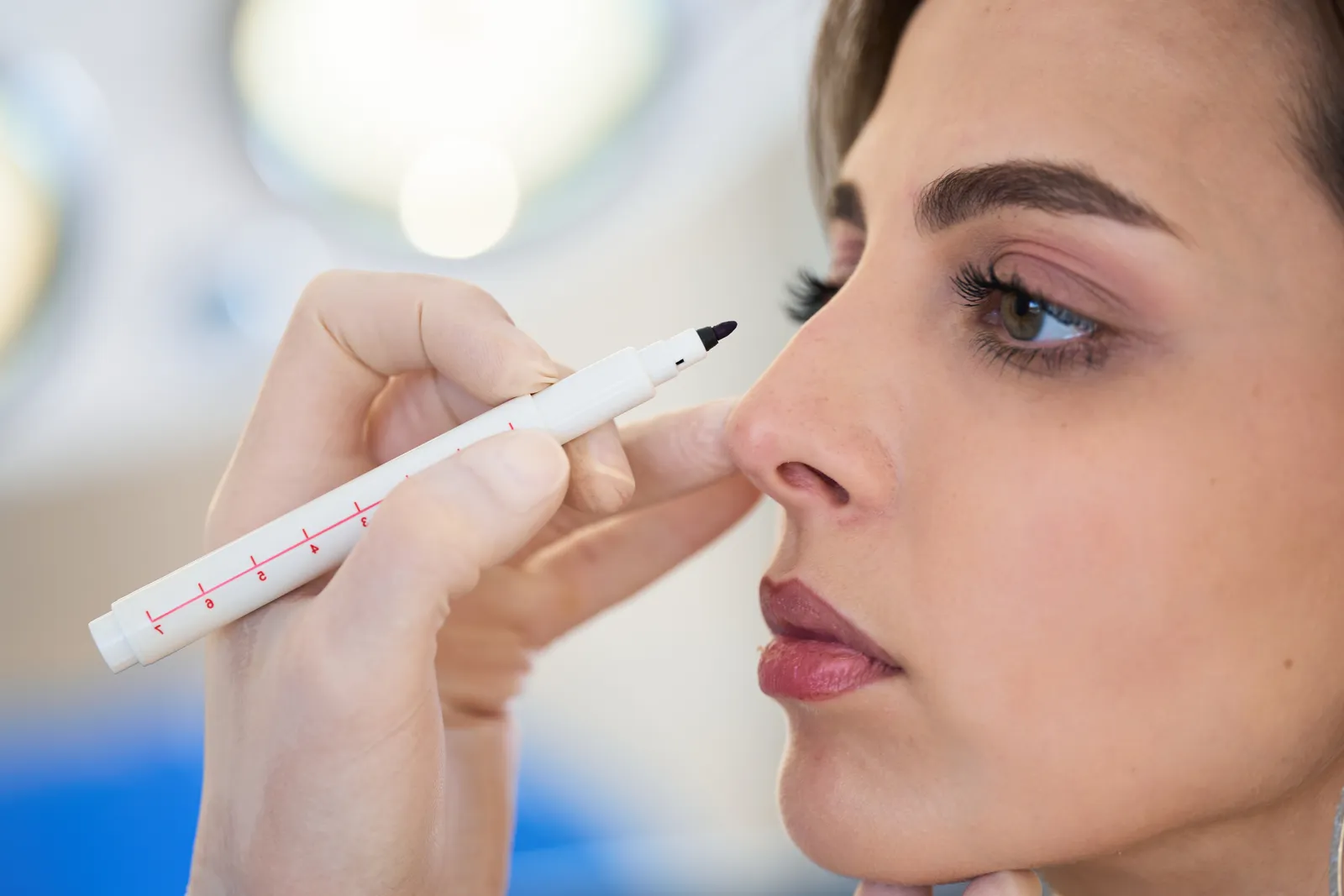
How open and closed rhinoplasty differ, what the columellar scar looks like and how healing compares day by day.
Open vs closed rhinoplasty is one of the first comparisons people run into when they start researching a nose job, and online forums tend to turn it into a contest. In reality, the approach is simply how the surgeon reaches the cartilage and bone. The shape you end up with depends far more on what the surgeon does once they are there, and how skilled they are with that approach.
This guide explains how each technique works, what the scar looks like, how the healing stages compare day by day, and how surgeons decide which one is right for a particular nose.
What is open rhinoplasty?
In open rhinoplasty, the surgeon makes a small incision across the columella, the narrow strip of skin between your nostrils, and joins it to incisions inside the nose. The skin is then gently lifted, giving the surgeon a direct, unobstructed view of the cartilage and bone framework.
That visibility is the main advantage. It allows precise reshaping of the tip, accurate placement and stitching of cartilage grafts, correction of significant asymmetry, and safer work in revision cases where previous surgery has left scar tissue.
The open rhinoplasty scar
The columellar incision is short and usually cut in a small step or inverted-V shape so it heals less noticeably. For most patients it fades to a fine line within a few months and is hard to spot at normal conversational distance. That said, nobody can promise an invisible scar. Skin type, healing tendency and aftercare all play a part, and in some people the line stays visible up close.
What is closed rhinoplasty?
In closed (endonasal) rhinoplasty, every incision is made inside the nostrils, so there is no external scar. The surgeon works through these openings with a more limited view, relying heavily on experience and feel. It is well suited to reducing a dorsal hump, narrowing the bridge and making moderate tip changes.
Advantages of closed rhinoplasty:
- no external incision or columellar scar;
- less of the soft tissue is lifted, so tip swelling is often a little less and may settle slightly sooner;
- simpler cases may take less operating time.
Limitations of closed rhinoplasty:
- restricted view, which makes detailed tip work and graft placement harder;
- less suitable for complex asymmetry and many revision cases;
- results depend heavily on the surgeon’s specific experience with the technique.
Open vs closed rhinoplasty: side-by-side comparison
| Factor | Open | Closed |
|---|---|---|
| Incisions | Inside the nose plus a small columellar incision | Inside the nose only |
| External scar | Fine line, usually subtle once healed | None |
| Surgeon’s view | Full and direct | Limited |
| Typically chosen for | Complex tips, grafts, asymmetry, revisions | Hump reduction, narrowing, moderate tip refinement |
| Tip swelling | Usually lasts longer | Often slightly less |
| Operating time | Generally longer | Can be shorter in simple cases |
If a surgeon recommends one approach, ask why. A good answer is specific: “your tip is wide and uneven, and I need to place a cartilage strut, so I’ll go open.” A weak answer is “it’s what everyone does” or “it’s cheaper”.
How surgeons decide which approach to use
The choice comes from your anatomy and your goals, not from a preference for one camp. Surgeons usually weigh these factors:
- What needs to change. A modest hump can often be handled closed. Lifting, narrowing or rebalancing the tip is usually more precise with an open approach.
- Skin thickness. Thick skin over the tip holds swelling longer and hides fine detail, which affects both technique and realistic expectations.
- Need for grafts. If your nose lacks structural support after injury or earlier surgery, cartilage from the septum, ear or rib may be used. Securing grafts precisely is generally easier open.
- The septum. A deviated septum that affects breathing can be corrected during the same operation with either approach.
- Previous surgery. In revisions, scar tissue changes the anatomy, and most surgeons prefer to see it directly.
It is perfectly fine to tell your surgeon you would rather avoid an external scar. But if they explain that your goals cannot be met reliably through a closed approach, it is better to hear that before surgery than to be disappointed a year later.
Anaesthesia
Both open and closed rhinoplasty are usually performed under general anaesthesia. An anaesthetist reviews your health history, allergies and medications beforehand. Small refinements are sometimes done under local anaesthesia with sedation, but that depends on the extent of the surgery and is the medical team’s decision.
Rhinoplasty recovery day by day
The overall recovery pattern is similar for both approaches. The main differences are how long tip swelling lingers and caring for the columellar stitches after open surgery.
- Days 1–3. Your nose feels blocked, and there is a splint or cast on the bridge. Swelling and bruising around the eyes build up, usually peaking around day 2 or 3. Sleep with your head raised, and use cold compresses if your surgeon allows. Most people describe the discomfort as a dull ache and pressure, managed with the pain relief prescribed.
- Days 4–7. Bruises turn yellow and fade, and breathing gradually improves. Avoid bending over, lifting and hot showers.
- Days 7–10. The splint comes off, along with columellar stitches after open surgery. You see your new nose for the first time, though it is still swollen.
- Weeks 2–3. Most visible swelling has gone down, and many people return to desk work and social plans.
- Months 1–3. The nose looks natural to others, but the tip may still feel firm or look a little full, especially in the morning.
- Months 6–12. The final contour emerges. After open surgery, and with thicker skin, this can take a year or longer.
Closed rhinoplasty healing stages
Closed rhinoplasty healing stages follow the same timeline, with one common difference: the tip often settles a little sooner because less tissue was lifted. Bruising, splint removal at around a week, and the return to normal activities at 2–3 weeks are much the same. The difference is real but smaller than many online posts suggest.
Caring for the columellar incision
After open rhinoplasty, keep the incision clean as shown by your nurse, avoid picking at crusts, and keep it dry in the first days unless told otherwise. Once the stitches are out and the skin has closed, your surgeon may suggest scar care and sun protection. Report redness, increasing pain or discharge promptly, even if you are already home.
Risks shared by both approaches
Any rhinoplasty carries risks: bleeding, infection, breathing difficulty, asymmetry, reduced sensation at the tip, dissatisfaction with the shape, and the possibility of needing a revision. Open surgery adds the question of how the columellar scar heals. Closed surgery carries a higher chance that a complex tip cannot be corrected as precisely as hoped. A good surgeon goes through all of this with you before you decide.
Planning rhinoplasty in Yerevan
For patients travelling to Armenia, the approach barely changes the trip length. Either way, plan on 7–10 days so your surgeon can remove the splint and, after open surgery, the stitches. Your surgeon decides when it is safe to fly after the check-up.
For an online consultation, send clear photos: front, both profiles, both three-quarter views and a view from below. From these, a surgeon can give a preliminary view of which approach makes sense for you. The final plan is confirmed only after an in-person examination. You can read more about the operation on our rhinoplasty page.
Frequently asked questions
Which is better, open or closed rhinoplasty?
Neither is better for everyone. Open is usually chosen for complex tip work, grafts and revisions; closed for more straightforward bridge and tip changes. Your surgeon recommends the approach after examining you.
Is the open rhinoplasty scar noticeable?
For most people it fades into a fine line that is hard to see at normal distance. An invisible scar cannot be guaranteed, as healing varies from person to person.
Does closed rhinoplasty heal faster?
Tip swelling is often slightly less after closed surgery, but the main milestones are similar: splint off at 7–10 days, most swelling gone in 2–3 weeks, final shape within about a year.
Is rhinoplasty painful?
You are asleep under general anaesthesia during surgery. Afterwards most patients report congestion and a dull ache rather than sharp pain, controlled with prescribed medication.
Can I choose the technique myself?
You can share your preference, but the technique should match your anatomy and goals. If your surgeon explains why a particular approach suits your nose, that reasoning is worth taking seriously.
Talk to a surgeon about your nose
Not sure which approach suits you? Send us your photos and we will arrange a free online consultation with a rhinoplasty surgeon in Yerevan, plus a personal estimate. Get in touch through our contact page whenever you are ready.
This article is for general information and does not replace a consultation with a qualified doctor.
Medical information notice
This article is general information for planning purposes and does not replace advice from a qualified medical professional.