Hair transplant for women: causes of hair loss and who is a candidate
Not every woman with thinning hair is a transplant candidate. Causes, diagnosis, unshaven techniques and what result to expect.
A hair transplant for women works well in specific situations: a high or receding hairline, localised thinning, scars, or traction alopecia from years of tight hairstyles. It is usually not the answer when thinning is diffuse across the whole scalp, because the donor area is affected too. So before talking technique, the first question is why the hair is falling out. This guide covers causes, candidacy, unshaven options and how to organise treatment in Yerevan, Armenia.
What causes hair loss in women?
Female hair loss has many causes, and some are temporary. The most common are:
- Female pattern hair loss: gradual thinning over the crown and parting, with the front hairline mostly preserved.
- Telogen effluvium: heavy shedding a few months after childbirth, crash dieting, a feverish illness, major stress or a change in medication. It usually recovers on its own.
- Traction alopecia: from tight ponytails, braids or extensions over years, mainly at the temples and front.
- Medical causes: thyroid problems, low iron, polycystic ovary syndrome or hormonal changes around menopause.
- Scarring alopecias and alopecia areata: these need specific dermatological treatment.
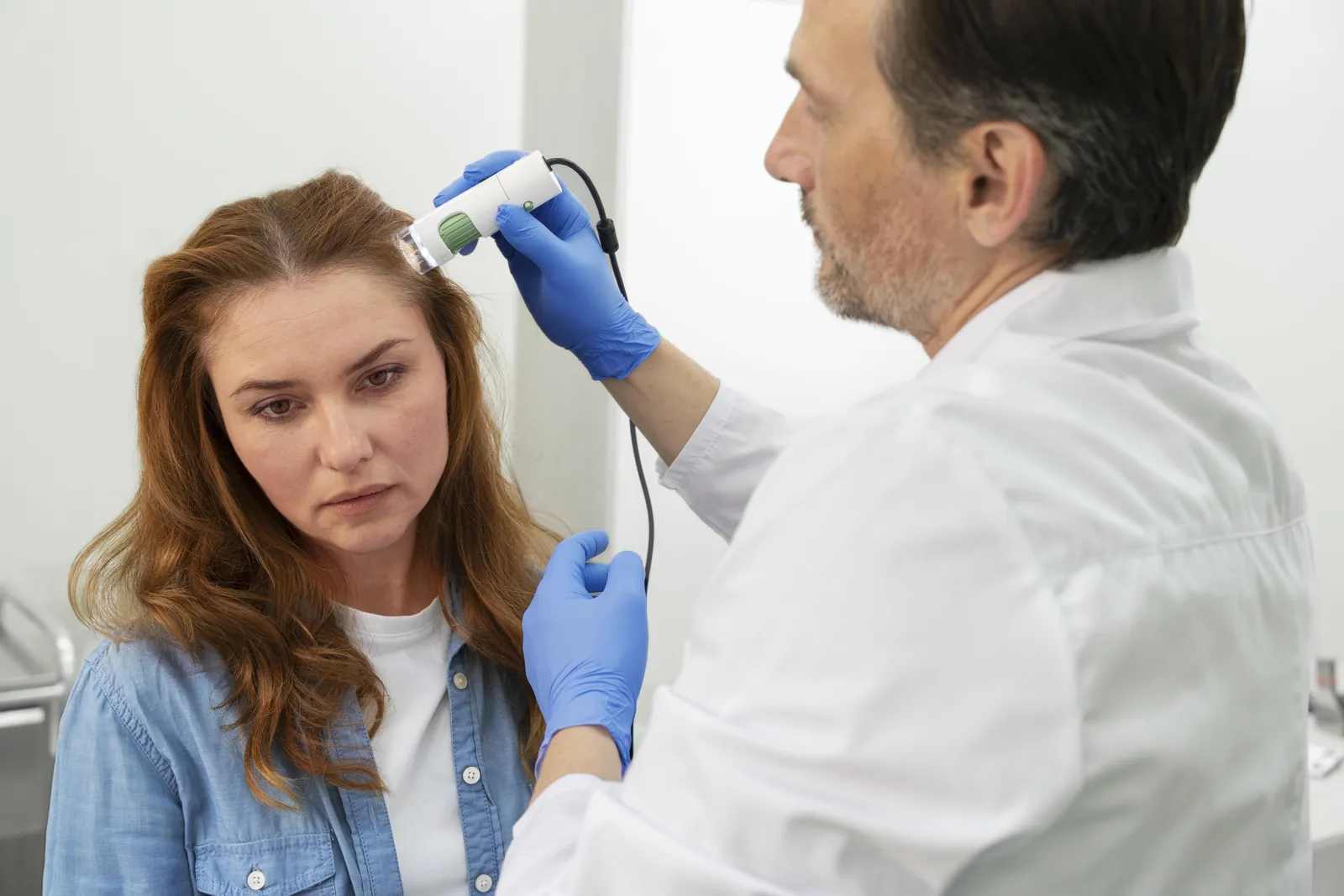
The first step is an assessment by a dermatologist or trichologist, with blood tests and trichoscopy. If there is an active medical cause, a transplant does not fix it and grafts may not take well.
Who is a good candidate for a female hair transplant?
| Situation | Usually a candidate? |
|---|---|
| Naturally high forehead or receding temples | Often, yes |
| Stable traction alopecia | Yes |
| Scars, for example after a facelift | Yes, depending on the skin |
| Thinner parting or crown with a strong donor area | In some cases |
| Diffuse thinning across the whole scalp, including the back | Usually not |
| Active telogen effluvium | No, wait for it to settle |
| Active scarring alopecia | Not while active |
The deciding factor is the donor area. If hair at the back of the head is dense and stable, there is material to redistribute. If it is thinning too, moving it makes little sense because those hairs may be lost anyway.
Hair transplant for women without shaving, and hairline options
Many women worry about having to shave their head. There are alternatives:
- Unshaven or partially shaven FUE: only a narrow strip at the back is trimmed and hidden under longer hair. It takes longer and usually limits the number of grafts per session.
- FUE with an implanter pen (DHI): grafts can be placed between existing hairs without cutting them in the recipient area.
- FUT (strip): a strip of scalp is taken from the back and closed as a fine linear scar that long hair covers. Some women prefer it precisely because no shaving is needed.
For a very high forehead, surgical hairline lowering (forehead reduction) can bring the hairline down in one operation; it can be compared with, or combined with, grafting. Your surgeon will explain which suits you.
Worth knowing: temporary shedding of native hair around the treated area (shock loss) is somewhat more common in women in the weeks after surgery. It usually recovers within a few months.
Hair transplant for women: recovery and before and after timeline
- Week 1: small crusts, some forehead swelling and tenderness at the back. Gentle washing as instructed.
- Weeks 2 to 6: transplanted hairs shed, sometimes with some nearby native hair. This is temporary.
- Months 3 to 4: new hairs begin to grow.
- Months 6 to 9: visible gain in density.
- Months 12 to 18: final result, especially over the crown and parting.
A transplant does not stop pattern hair loss in untreated hair. Many patients continue medical treatment prescribed by their dermatologist, such as minoxidil or other drugs depending on their case, sometimes with PRP as an add-on. Some medicines used in men are not recommended for women who could become pregnant; that decision always belongs to the doctor.
Female hair transplant in Yerevan: stay, flights and follow-up
Plan 3 to 4 days in Yerevan: consultation and design, the procedure, a check-up and the first wash. Flying one or two days later is usually fine. Pack a loose scarf or cap that does not press on the grafts.
For the first two weeks, skip saunas, swimming, hard exercise and direct sun on the scalp. Hair colouring is usually postponed for around a month; your doctor will give the exact timing. Sleeping with your head raised for the first nights helps forehead swelling settle.
Follow-up continues by photos at months 1, 3, 6 and 12, and your dermatologist at home can continue medical treatment. Read more about the technique on our hair transplant page.
How much does a hair transplant for women cost?
Cost is calculated mainly by the number of grafts and depends on the technique (shaven or unshaven, FUE, DHI or FUT), the number of sessions, and what the package includes: transfers, accommodation and aftercare. Unshaven work often takes longer, which can affect the price. We do not publish fixed figures; send your photos and we will prepare a personal estimate. See everything we coordinate on our services page.
Frequently asked questions
Can women get hair transplants?
Yes, when the cause of hair loss is diagnosed and the donor area is good. The best results are seen with receding temples, high foreheads, traction alopecia and scars.
Can a woman have a hair transplant without shaving?
Yes. Unshaven FUE, DHI or FUT avoid shaving the head; sometimes only a narrow strip at the back is trimmed and hidden under longer hair.
Does a hair transplant work for women with thin hair?
It can, if the donor area is stable, although fine hair gives less visual density. Your surgeon will assess this at consultation.
How long is recovery after a hair transplant for women?
Most women return to normal routines within a week. New growth starts at 3 to 4 months and the final result is judged at 12 to 18 months.
Is a hair transplant permanent for women?
Hairs taken from a stable donor area usually last, but native hair may keep thinning if the underlying cause is not treated.
To find out whether you are a candidate, send photos of the top, front and back of your head through our contact page. We will arrange a free online consultation with a Yerevan specialist and a personal estimate.
This article is for general information and does not replace a consultation with a qualified doctor.
Medical information notice
This article is general information for planning purposes and does not replace advice from a qualified medical professional.