How many grafts do I need? Norwood scale and donor area explained
Typical graft ranges by Norwood stage, how donor capacity is judged, and what to ask before you accept any number in a quote.
“How many grafts do I need?” is usually the first question anyone asks before a hair transplant, and for good reason: that number shapes the result, the length of surgery and the budget. The short answer is that it depends on three things: how much area needs covering (your Norwood stage), what density you want, and how many follicles your donor area can give without looking thin.
Below are the typical ranges surgeons work with, how donor capacity is assessed, and why the final figure is set by a specialist after examining your scalp, whether at home or at a clinic in Yerevan, Armenia.
Grafts, follicular units and hairs: not the same thing
Many misunderstandings start with vocabulary, so it helps to be clear:
- Graft or follicular unit: the natural group of 1 to 4 hairs that grow together and are harvested as one unit.
- Hairs: the total number of strands. On average a graft holds a little over 2 hairs, so 2,000 grafts usually mean roughly 4,000 to 4,500 hairs.
- Density: grafts placed per square centimetre. The hairline gets more density than the crown.
When you compare quotes, check whether they count grafts or hairs. “5,000 hairs” is a very different offer from 5,000 grafts.
How many grafts do I need for each Norwood stage?
The Norwood scale grades male pattern hair loss from 1 (no real recession) to 7 (only a horseshoe of hair remains). The ranges below are those commonly cited in clinical practice. They are not a promise or a quote: your own number may be higher or lower.
| Norwood stage | Area to cover | Typical grafts |
|---|---|---|
| 2 | Mild temple recession | 800 to 1,500 |
| 3 and 3 vertex | Deeper temples, sometimes early crown | 1,500 to 2,500 |
| 4 | Wider front and separate crown | 2,500 to 3,500 |
| 5 | Front and crown almost joined | 3,000 to 4,500 |
| 6 | Whole top of the head | 4,000 to 6,000, often in two sessions |
| 7 | Extensive baldness | Over 5,000; donor supply may fall short |
For women the Ludwig scale is used and the logic changes: loss is often diffuse and not every woman is a candidate. The crown deserves a special mention too. Surgeons call it a “black hole” because it absorbs a lot of grafts and the visual effect takes longer to show.
How many grafts do I need for a receding hairline?
For a receding hairline at Norwood 2 or 3, quotes typically fall between about 1,000 and 2,500 grafts. Where you sit in that range depends on how far back the temples go, how low the new line is designed and how dense you want the front third to look. A slightly higher, mature hairline uses fewer grafts and ages better than a low, straight one.
How much can your donor area give?
The donor zone at the back and sides of the head is a finite resource. Hair removed from it does not grow back there, so a good surgeon plans for your whole life, not just this year’s operation.
What is assessed at consultation:
- Donor density: follicular units per square centimetre, which varies a lot between people.
- Safe donor area: the zone where hair is stable long term.
- Hair calibre and curl: thick or wavy hair covers more with fewer grafts.
- Colour contrast between hair and skin: less contrast looks denser.
- Age and expected progression: at 25, grafts must be kept in reserve for future loss.
Lifetime donor reserve differs widely from person to person. Over-harvesting leaves a patchy, “moth-eaten” back of the head that is hard to fix.
One session or two?
Many clinics perform FUE or DHI in sessions of 2,000 to 4,000 grafts, depending on technique, team and donor area. If you need more, it is often wiser to split the work into two sessions about 12 months apart, so the first result can grow in and guide the second.
Be wary of “unlimited grafts” deals or very high numbers in one day without a donor assessment. More is not always better: distribution, hairline design and graft survival matter more.
How the graft count affects cost
Clinics usually price per graft or per session with a graft cap. Either way, check what is included: technique (FUE, DHI, unshaven), who performs each step, blood tests, anaesthesia, medication, washes, hotel nights, transfers, interpreter and follow-up, and whether a second session is priced differently. Medarmenia does not quote per-graft prices blind: we ask for photos and prepare a personal estimate based on the surgeon’s assessment.
Getting a graft estimate and having surgery in Yerevan
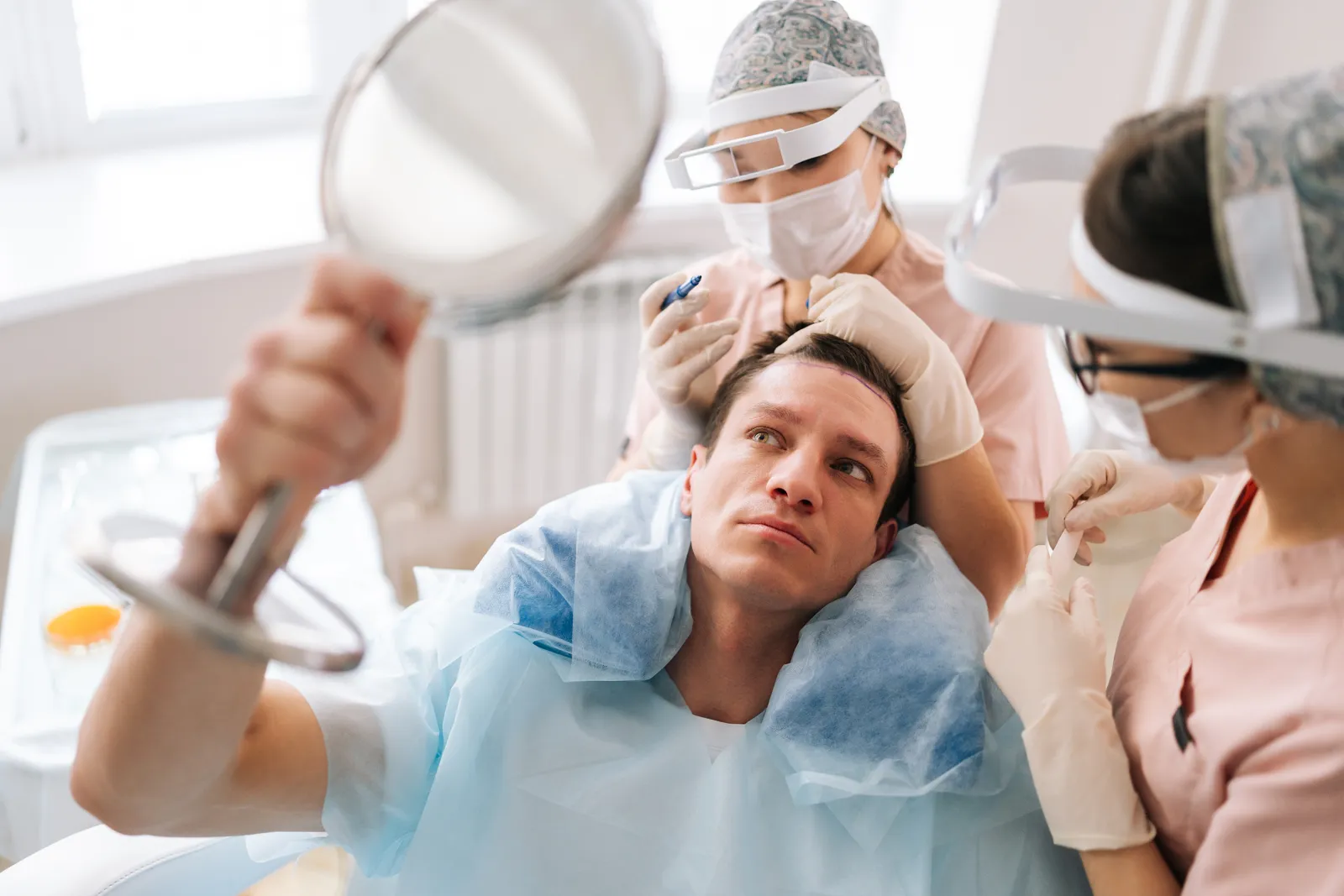
Online graft calculators give a rough idea, but they cannot see your donor area. For a serious estimate a surgeon needs sharp photos from the front, both sides, the crown from above and the back of the head with short hair. That is enough to propose a range and a hairline; the final figure is confirmed in person, sometimes with trichoscopy.
If you have your hair transplant in Yerevan, plan on 3 to 5 days. Clinics typically work in Armenian, Russian and English, and Medarmenia coordinates communication and interpreters. Check current entry rules for your nationality before booking. Follow-ups at 3, 6 and 12 months are done remotely with photos.
Frequently asked questions
How many grafts do I need for a full head?
Restoring the whole top at Norwood 6 commonly needs 4,000 to 6,000 grafts or more, usually across two sessions. Whether that is possible depends on your donor area.
Is 2,000 grafts a lot?
It is a common number for a moderate frontal area. Whether it is enough depends on the area to cover and your hair type.
Can the donor area run out?
Yes. Over-harvesting can leave it visibly thinner, which is why extraction must be spread out and respect your donor capacity.
Can beard or body hair be used?
In selected cases with a weak donor area, some surgeons add beard hair. Results are less predictable and it is not a first choice.
Will I need another transplant later?
Possibly, if hair loss continues. Medical treatment prescribed by your doctor helps reduce that likelihood.
Want to know your own number? Send us your photos and we will arrange an online assessment with a hair surgeon in Yerevan and a personal estimate, with no obligation.
This article is for general information and does not replace a consultation with a qualified doctor.
Medical information notice
This article is general information for planning purposes and does not replace advice from a qualified medical professional.