Ptosis surgery for droopy eyelids: cosmetic or functional, and recovery
Droopy eyelid? How to tell true ptosis from excess skin, which ptosis surgery suits each case and what recovery looks like day by day.
Ptosis surgery lifts an upper eyelid whose edge droops because the muscle that raises it, or its tendon, has weakened or stretched. That’s different from excess eyelid skin (dermatochalasis), although the two are often confused and sometimes appear together. The difference matters: blepharoplasty removes skin, while ptosis repair tightens or reattaches the muscle. When the lid covers part of the pupil and limits vision, it is a functional problem; when it simply makes you look tired, it is mainly cosmetic.
Below we explain diagnosis, the main techniques and how surgery can be planned in Yerevan, Armenia.
Ptosis or excess skin: how to tell the difference
| Feature | Ptosis | Dermatochalasis (excess skin) |
|---|---|---|
| What droops | The lid margin and lashes | A fold of skin above the lid |
| Cause | Weak or detached levator muscle or tendon | Skin ageing, genetics |
| Typical sign | Raising your brows to see; tired forehead | Heavy feeling, skin touching the lashes |
| Treatment | Ptosis repair | Blepharoplasty |
The brow can also sag (brow ptosis) and push skin towards the eye. Many people have a mix of all three, which is why accurate diagnosis is the foundation of a good result. If yours is mainly excess skin, see our blepharoplasty page.
What causes a droopy eyelid, and when is it urgent?
- Aponeurotic (age-related): the most common type in adults. The muscle’s tendon stretches with age, long-term contact lens wear or after eye surgery.
- Congenital: present from birth. In children it is monitored because it can affect visual development.
- Neurological or muscular: due to nerve problems or conditions such as myasthenia gravis, where the lid droops more as the day goes on.
- Temporary after Botox: if the toxin spreads to the lifting muscle. It usually resolves on its own within weeks.
Important: ptosis that appears suddenly, especially with double vision, a severe headache or one pupil larger than the other, is a medical emergency. Go to A&E or the emergency room, not a cosmetic clinic.
When is ptosis surgery functional and when cosmetic?
The specialist measures the distance between the lid margin and the light reflex on your pupil, the strength of the lifting muscle and, if needed, your visual field. If the lid cuts off your upper vision or forces you to tilt your chin or raise your brows, it is classed as functional.
In many health systems, ptosis that limits the visual field may be covered by public healthcare or insurance, while purely cosmetic correction is usually private. Criteria and waiting times vary, so check your own system and policy.
Ptosis surgery techniques
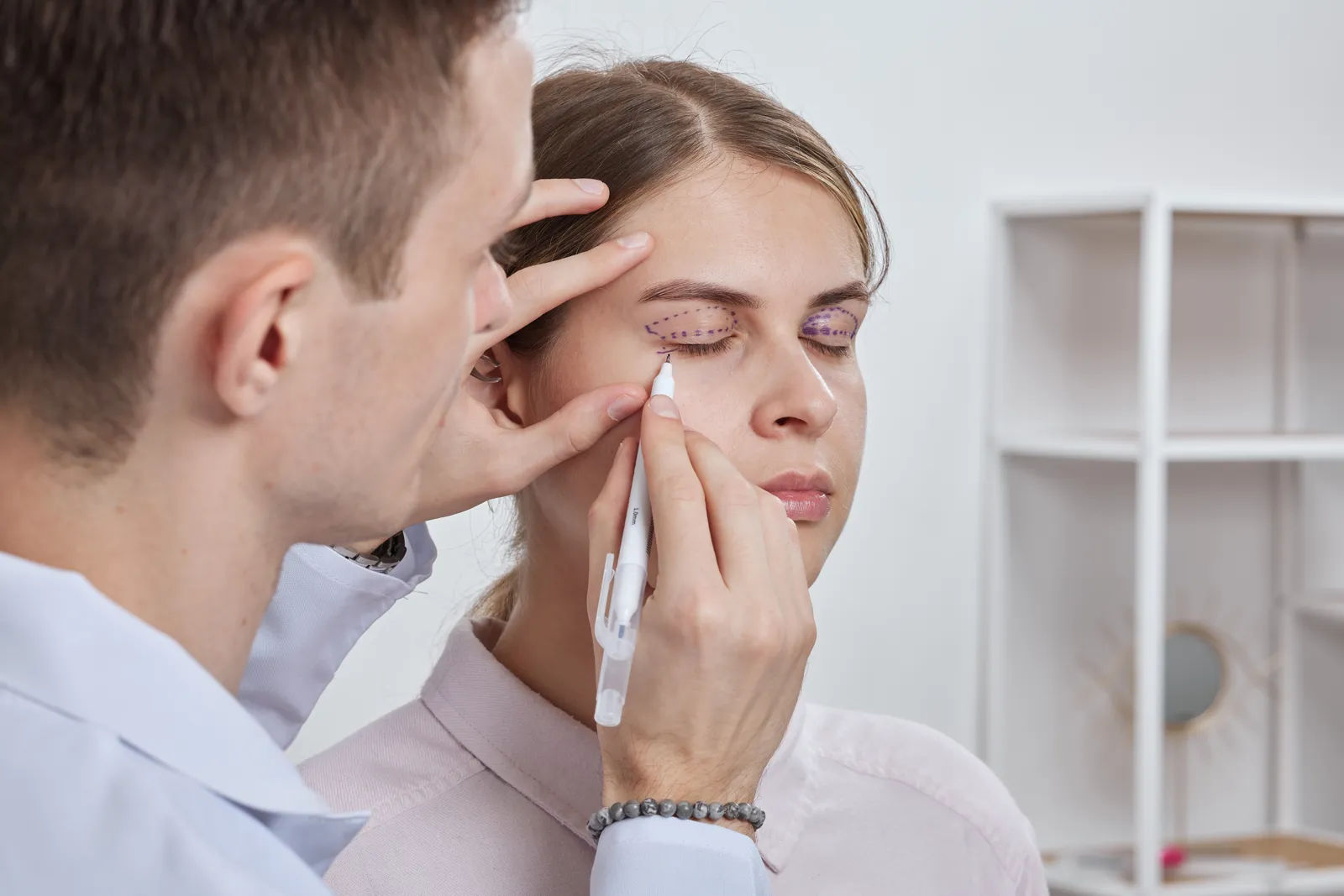
The technique is chosen by an oculoplastic surgeon (an ophthalmologist specialising in eyelids) or a plastic surgeon experienced in ptosis, based on muscle strength:
- Levator advancement: through an incision in the eyelid crease, which hides the scar. The most common technique for adult ptosis and easy to combine with blepharoplasty.
- Müller muscle resection from the inside: through the inner surface of the lid, with no visible skin scar. For mild ptosis that responds well to a test eye drop.
- Frontalis sling: when the lifting muscle barely works, for example in some congenital cases. The lid is linked to the forehead muscle with a material or tissue.
It is usually done under local anaesthetic with light sedation, so the surgeon can ask you to open your eyes during the operation to fine-tune height and symmetry. It takes roughly 45 to 90 minutes depending on whether one or both lids are treated and whether another procedure is combined.
Ptosis surgery recovery day by day, and risks
- Days 1–3: swelling and bruising; cold compresses, head raised when sleeping, artificial tears and prescribed ointment.
- Days 5–7: stitch removal if not dissolvable. Many people return to work, with sunglasses, during the second week.
- Weeks 2–6: swelling settles and lid height stabilises. At first, closing the eye fully during sleep may be difficult.
- Months 2–3: close to the final result.
Risks: under- or over-correction, asymmetry, dry eye, incomplete eyelid closure, irregular crease shape and infection (rare). Some patients need a small touch-up, and a good surgeon tells you this upfront.
Ptosis surgery in Yerevan: stay and follow-up
In Yerevan, ptosis surgery is performed by oculoplastic ophthalmologists and plastic surgeons experienced in eyelid work. Medarmenia checks who will operate, which technique is proposed and whether combining it with blepharoplasty makes sense, before you book your trip.
- Length of stay: about 6–8 days, for a check-up and stitch removal.
- Flying: many surgeons allow flying a few days after surgery if there are no complications; carry artificial tears for dry cabin air.
- Back home: a check with your local eye doctor, and progress photos sent to the Yerevan team at a few weeks and months.
Cost depends on whether one or both lids are treated, the technique, whether blepharoplasty or a brow lift is added and the type of anaesthesia. We give you a personal estimate after reviewing your photos.
Frequently asked questions
Can ptosis be fixed without surgery?
For mild cases there are eye drops that lift the lid for a few hours, but the effect is temporary. Botox-related ptosis improves on its own. For a lasting correction, surgery is the option.
Is the ptosis surgery scar visible?
With the external approach it sits in the natural lid crease and is usually hard to see after a few months. The internal approach leaves no skin scar.
Can I have ptosis surgery and blepharoplasty together?
Yes, it’s a common combination if you have both problems. Your surgeon decides whether it is safe to do both in one session.
How long does ptosis surgery last?
Results are usually long-lasting, although ageing continues and the lid may drop slightly again over the years.
Is ptosis surgery painful?
Under local anaesthetic you feel the initial injection and some pressure. Afterwards there is mild discomfort and tightness managed with ordinary painkillers.
Have a droopy lid and not sure whether it’s ptosis or excess skin? Send us front-facing photos with your eyes open and looking up. We’ll arrange an online consultation with a specialist and a personal estimate.
This article is for general information and does not replace a consultation with a qualified doctor.
Medical information notice
This article is general information for planning purposes and does not replace advice from a qualified medical professional.